Children’s eyewear is the quiet growth engine of the optical industry. While headlines focus on smart glasses and luxury collaborations, the kids segment is compounding at nearly 10% a year — driven by a global wave of childhood myopia and a generation of parents who buy UV protection for their toddlers the way previous generations bought sunscreen. For B2B buyers, this is a category where demand is rising faster than supply sophistication, which means opportunity.
But sourcing children’s eyewear is not the same as sourcing for adults. The safety standards are mandatory, not optional. The materials have to survive a playground. And the fit has to work on a face that changes shape every six months. This guide walks through what every B2B buyer needs to know before placing a children’s eyewear order.
Key takeaways
- The children’s eyewear segment is growing at ~9.65% CAGR, outpacing the overall eyewear market. Childhood myopia is projected to affect 740 million children by 2050.
- Safety standards are non-negotiable — CPSIA in the US, REACH + CE in the EU, and impact-resistance requirements in every major market. A factory that cannot produce third-party test reports is not a viable supplier.
- TR90 is the dominant kids frame material — ultra-light, flexible, nearly unbreakable in normal use. Silicone is used for the youngest age group.
- Spring hinges, silicone nose pads, and flexible temples are essential — not nice-to-have features. They prevent breakage and injury.
- MOQ starts at 300-500 pieces per style for custom production; ready stock is available from 1 piece.
Why the kids eyewear market is exploding
The numbers tell a clear story. The children’s eyewear segment is growing at approximately 9.65% CAGR, well above the 7-8% of the broader eyewear market. Behind that growth are three structural forces that are not going away:
1. The myopia epidemic. Global childhood myopia prevalence is rising sharply. A meta-analysis published in major ophthalmology journals puts smartphone-related myopia in children at 31.4%, and TV/computer-game-related myopia at 35.4%. Projections estimate that by 2050, 39.8% of children and adolescents globally — roughly 740 million individuals — will be myopic. Every one of those diagnoses creates demand for at least one pair of corrective frames, and usually more (spares, sports, sunglasses).
2. UV awareness among parents. A generation of parents raised on sunscreen and SPF messaging now applies the same logic to eye protection. Children’s sunglasses are no longer a fashion accessory — they are a health product. The global children’s sunglasses segment is growing in parallel with prescription frames, and many brands now bundle both in a “back to school” procurement cycle.
3. Government screening programs. Countries across Asia and Europe are scaling school-based vision screening, identifying millions of previously undiagnosed children. Each screening event generates downstream demand for affordable, durable, child-safe frames. For B2B suppliers, the institutional procurement channel — supplying optical chains and government health programs — represents a distinct and growing order stream.
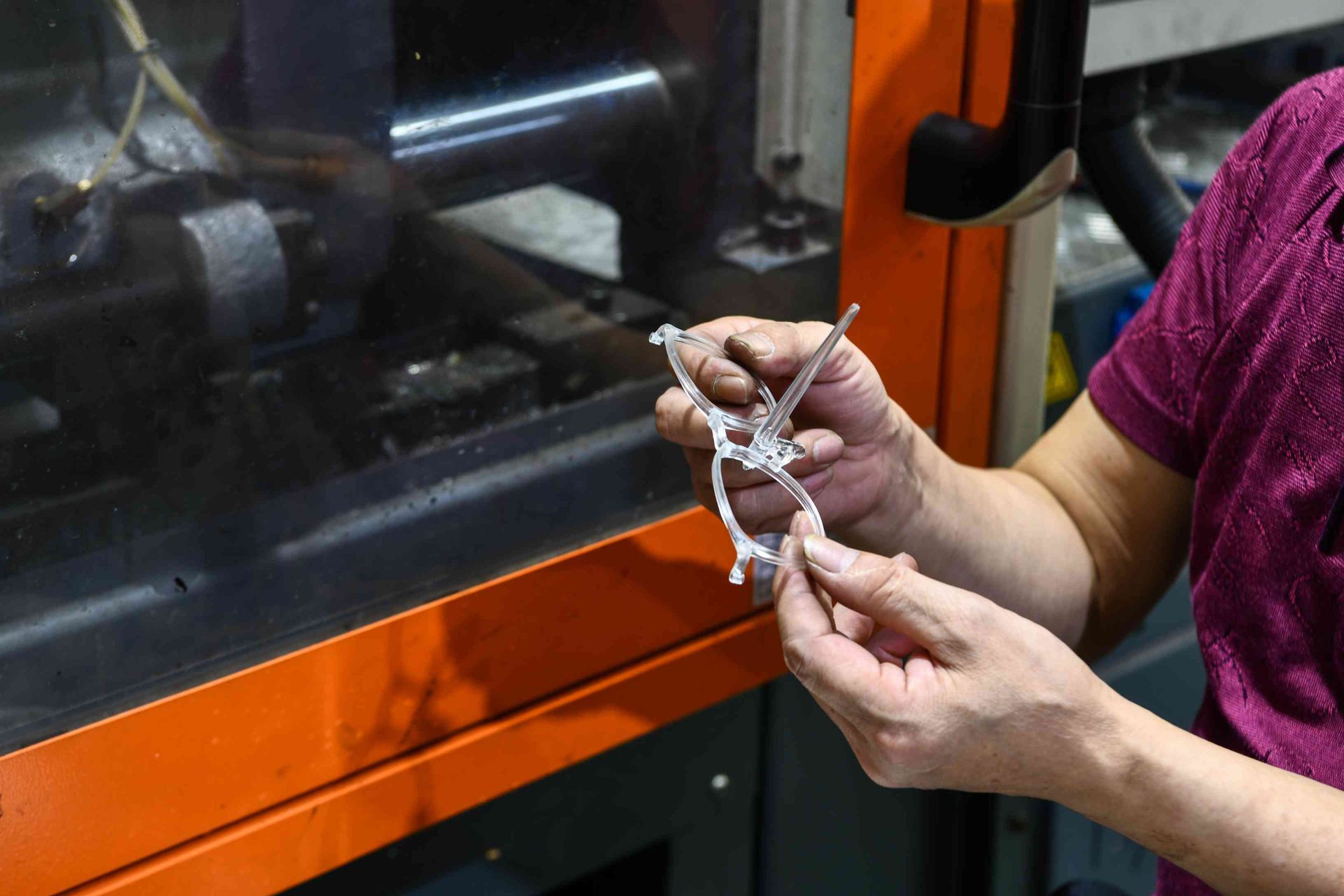 TR90 injection molding produces frames that are light enough for a child’s face, flexible enough to survive daily abuse, and affordable enough for high-volume procurement.
Safety standards: the rules you cannot skip
This is the most important section of this guide. In adult eyewear, safety standards are largely about material compliance and quality management. In children’s eyewear, they are about physical safety — preventing eye injury from lens shatter, frame breakage, and toxic materials. Missing a standard can mean a product recall, a customs rejection, or worse.
United States
| Standard | What it covers | What you need |
|---|---|---|
| CPSIA | Lead content (<100 ppm in surface coatings and substrates), phthalate limits, third-party testing requirement for children’s products | CPSC-accepted lab test report |
| FDA 21 CFR 801.410 | Impact-resistant lenses (drop ball test) — mandatory for all prescription eyewear and sunglasses sold in the US | Batch test certification |
| California Proposition 65 | Additional chemical disclosure requirements | Warning label or compliance certificate if selling in California |
| ASTM F803 | Eye protectors for sports — applies if marketing frames for sports use | Impact rating certification |
European Union
| Standard | What it covers | What you need |
|---|---|---|
| REACH | Chemical substance restrictions (nickel release, phthalates, heavy metals) | REACH compliance declaration + test reports |
| CE Marking | Conformity with EU health, safety, and environmental requirements | CE Declaration of Conformity |
| EN 166 | Personal eye protection — applies to children’s sunglasses and sports eyewear | Notified body assessment for Category II PPE |
| Regulation (EU) 2016/425 | Personal protective equipment — covers children’s sunglasses with UV protection claims | EU-type examination certificate |
Other key markets
| Market | Standard |
|---|---|
| Australia / New Zealand | AS/NZS 1067 (sunglasses and fashion spectacles) |
| Canada | Canada Consumer Product Safety Act (CCPSA) — similar to CPSIA |
| Japan | JIS T 7333 for spectacle frames |
| South Korea | KC Mark certification for children’s products |
A reputable children’s eyewear manufacturer will proactively provide third-party lab test reports covering the standards relevant to your target market. If a factory cannot produce these — or suggests they are unnecessary — look elsewhere. The cost of non-compliance (recall, liability, reputational damage) exceeds any per-unit savings.
Frame materials: which ones work for kids
A child’s frame has to do things an adult frame doesn’t. It has to survive being sat on, dropped from head height, pulled off one-handed, and tossed into a school bag. It has to be light enough that a six-year-old forgets they are wearing it. And it has to be made of something that does not snap into sharp edges when it eventually breaks.
| Material | Weight per frame | Flexibility | Breakage risk | Best age range | Relative cost |
|---|---|---|---|---|---|
| TR90 | 12–15 g | Very high — bends without breaking | Very low | 3–16 years | $–$$ |
| Silicone | 8–12 g | Extreme — twistable, chewable | Near zero | 0–4 years | $$ |
| Flexible stainless steel | 14–18 g | Moderate — spring temples | Low | 7–16 years | $$–$$$ |
| Beta-titanium | 13–17 g | High — flexible and shape-memory | Low | 8–16 years | $$$ |
| Standard acetate | 18–25 g | Low — rigid, can snap | Moderate–high | 12+ years only | $$–$$$ |
| Standard metal alloy | 16–24 g | Low — bends permanently | Moderate | 12+ years only | $–$$ |
TR90: the workhorse of children’s eyewear
TR90 (a brand name for a Swiss-developed thermoplastic polyamide) is the dominant material in children’s frames for good reason. It combines three properties that no other material matches at the same price point:
- Ultra-light weight (12-15g per frame) — critical for children whose nose bridges are not fully developed and cannot support heavier frames comfortably.
- Exceptional flexibility — TR90 can be twisted, bent, and dropped without permanent deformation. When it does reach its failure point, it tends to deform rather than shatter, which is a safety advantage.
- 50+ color options — children’s frames sell on color as much as on fit. TR90’s injection-molding process allows bright, saturated colors that appeal to children and parents alike.
Our factory’s injection workshop produces 5,000 TR90 frames per day — making it the most scalable material for children’s eyewear programs.
Silicone: for the youngest wearers
For infants and toddlers (0-4 years), silicone frames are the safest option available. They are effectively unbreakable in normal use, soft against the skin, and chewable — which matters for a demographic that puts everything in their mouth. The trade-off is higher per-unit cost than TR90 and fewer color and shape options. Silicone frames are most commonly found in the infant and early-toddler segment, often paired with an elastic headband instead of traditional temples.
Flexible metal (stainless steel and beta-titanium)
For older children (7+), flexible metal frames offer a more “grown-up” aesthetic while maintaining adequate durability. Key features: spring hinges, flexible temple cores, and corrosion-resistant finishes. Beta-titanium — covered in depth in our titanium eyewear manufacturing guide — is the premium option for older children’s frames, combining lightness with exceptional flexibility.
Frame design: the features that matter
Even with the right material, poor design choices make a frame fail. Here is what to specify when sourcing children’s eyewear:
Spring hinges (non-negotiable)
Standard barrel hinges on children’s frames are a failure point. Children pull glasses off one-handed, stretching the temple outward at an angle the hinge was not designed to handle. Spring hinges — which allow the temple to flex outward beyond 90 degrees and spring back into position — reduce breakage by an estimated 60-80% compared to standard hinges. They add roughly $0.30-0.80 to the per-unit cost and are worth every cent.
Silicone or soft PVC nose pads
Children — especially younger ones — have low, underdeveloped nose bridges. Frames designed for adult nose geometry slide down constantly. The fix: soft, adjustable nose pads (silicone or PVC) mounted on flexible pad arms that can be adjusted by an optician. For the youngest age group, a saddle bridge design with integrated soft material often works better than separate pad arms.
Deep lens grooves
A child’s frame experiences more impact than an adult’s — drops, sports, playground collisions. A lens that pops out on impact is both a nuisance and a safety hazard if the exposed frame edge contacts the eye. Deep lens grooves (1.2mm minimum, ideally 1.5mm) hold the lens securely during impact. Confirm this specification with your manufacturer before production.
Flexible, rounded temple tips
Temple tips should be made of soft, hypoallergenic material (silicone or soft TR90 compound), rounded at the ends — no sharp edges — and long enough to curve behind the ear for a secure fit. Some children’s frames for the youngest age group replace temples entirely with an adjustable elastic strap, which is both safer and more secure for active toddlers.
Wrap-around design for sunglasses
Children’s sunglasses should provide full orbital coverage — not just front-facing tint. Peripheral UV exposure contributes to long-term eye damage, and a wrap-around or well-contoured frame blocks light from the sides and top. Look for a minimum 6-base curve on sunglass fronts, with temples wide enough to block side light.
Age segmentation: one size does not fit all
Children’s eyewear is not one category — it spans from infancy to late teens, with different requirements at each stage. B2B buyers should think in age bands, not a single “kids” bucket.
| Age band | Key requirement | Best material | Typical frame width | Typical temple length |
|---|---|---|---|---|
| 0–2 years (Infant) | Maximum safety, elastic strap | Silicone | 90–100mm | Strap: 40–50cm adjustable |
| 3–6 years (Toddler/Preschool) | Light weight, spring hinges, bright colors | TR90, Silicone | 105–115mm | 115–125mm |
| 7–10 years (Junior) | Durability, school-ready, UV protection | TR90, Flexible metal | 118–128mm | 125–135mm |
| 11–14 years (Tween) | Style-conscious, bridge fit | TR90, Beta-titanium, Thin acetate | 125–135mm | 130–140mm |
| 15–17 years (Teen) | Near-adult sizing, trend alignment | All adult materials | 128–140mm | 135–145mm |
The 7-10 age band typically represents the largest volume segment for B2B — these are the peak myopia-diagnosis years and the age at which children are most likely to need a replacement pair due to breakage or growth.
MOQ, pricing, and lead times
MOQ
| Order type | MOQ | Notes |
|---|---|---|
| Custom OEM (new design, any material) | 300–500 pcs/style | Slightly lower than adult eyewear due to less material per unit |
| Custom OEM (existing mold, new color) | 200–300 pcs/style | Lower because tooling exists |
| Custom ODM (factory design, your brand) | 300–500 pcs/style | Faster path to market |
| Ready stock | 1 pc/style | Mix and match from catalog; ideal for market testing |
Pricing
Children’s frames are generally 10-20% less expensive to produce than equivalent adult frames due to smaller material consumption. However, safety-standard compliance (third-party testing, documentation) adds a fixed cost per SKU that should be budgeted. Typical costs:
- TR90 children’s frames (custom OEM): $1.50-4.00/unit FOB at MOQ, depending on complexity and finish
- Silicone infant frames: $2.50-5.00/unit FOB at MOQ
- Flexible metal children’s frames: $3.00-8.00/unit FOB at MOQ
- Third-party safety testing: budget $300-800 per SKU for CPSIA + REACH + impact test package (one-time cost for the production run)
Lead times
| Stage | Timeline |
|---|---|
| Design & quotation | 2-5 working days |
| Sampling | 10-14 working days |
| Safety testing | 5-10 working days (parallel with sampling, if planned) |
| Bulk production | 25-35 working days |
| Ready stock fulfillment | ~7 working days |
Include safety testing in your timeline from day one — do not leave it as a post-production afterthought. A factory with established testing lab relationships can run compliance tests in parallel with sampling, saving 1-2 weeks.
Sourcing children’s eyewear from China
Danyang, Jiangsu — the eyewear capital that produces roughly 50% of the world’s lenses — is also a significant production hub for children’s frames. The same advantages that apply to adult eyewear sourcing (integrated supply chain, skilled labor, material access) apply to the children’s segment, with one critical addition: regulatory fluency. A factory that exports children’s eyewear to the US and EU has already navigated CPSIA, REACH, and CE compliance. Using that factory means your order inherits their testing infrastructure and documentation pipeline.
When evaluating a children’s eyewear manufacturer, ask for:
- Existing third-party test reports — any factory serious about children’s eyewear will have recent CPSIA and REACH test reports from accredited labs (SGS, Intertek, Bureau Veritas, TÜV). Ask to see them.
- Material certificates for every component — frame material, nose pads, temple tips, hinges, screws, coatings. Children’s products require traceability at the material level.
- Design file showing compliance features — spring hinge specification, lens groove depth, edge radius (no sharp edges), temple tip material. A good factory’s design files will already include these.
- Production samples from a recent children’s order — not prototypes made for your inquiry, but actual production pieces. Examine them for the quality indicators described above.
- Age-grade labeling capability — most markets require age-grade labeling on children’s products (e.g., “3+”). Confirm the factory can print or engrave this on the frame or packaging.
Start with a small trial order — 100-200 pieces across 3-5 styles is a typical test run for children’s eyewear — and verify both the product and the compliance documentation before scaling. A serious factory will support this approach, because they know the children’s segment is built on trust and track record, not on a single large order.
For more on vetting manufacturers, see our 10-point eyewear manufacturer checklist and certifications guide. For insight into why Danyang’s supply chain is uniquely suited to children’s eyewear production, read why Danyang is the eyewear capital.
Is the children’s segment right for your business?
Children’s eyewear is a different business model than adult eyewear. The unit economics are slightly lower (smaller frames = less material = lower per-unit cost, but also lower per-unit retail price). What compensates is frequency: children replace frames far more often than adults — growth, breakage, and loss drive a replacement cycle that is 2-3× faster than the adult market. A single child may go through 2-4 frames between ages 6 and 16, compared to 1-2 frames for an adult over the same period. That repeat-purchase dynamic is what makes the segment economically attractive despite the lower per-unit price.
The second advantage is channel loyalty. Once a parent finds a brand or optical practice that fits their child well and handles the process smoothly, switching costs are high. The child knows the frames, the fit is dialed in, and the parent trusts the safety track record. This makes children’s eyewear a strong retention category for optometry practices and a sticky product line for DTC brands.
Sourcing children’s eyewear for your brand or practice? Tell us your age range, material preference, volume, and target market. We respond within 24 hours with a tailored proposal, including compliance documentation, pricing, and a sample plan. Request a quote or browse our ready-stock children’s selection.