Titanium eyewear occupies a unique position in the B2B market: it’s the material buyers aspire to stock but often hesitate to source, held back by questions about cost, authenticity, and whether their market will pay the premium. This guide removes the guesswork. Written from the factory floor, it covers everything a professional buyer needs to evaluate, specify, and source titanium frames — from the metallurgy to the minimum order.
Key takeaways
- Pure titanium (>99% Ti) offers the lightest weight and highest biocompatibility; beta titanium (titanium alloy) trades a few grams for superior flexibility and shape memory.
- Titanium frames cost 2–4× more than TR90 and 1.5–3× more than standard acetate at the unit level — but command the highest retail margins in the optical category.
- Manufacturing titanium is harder: slower machining, more demanding welding, and stricter QC. Not every factory can do it well.
- The MOQ is ~500 pieces per style for custom OEM; ready-stock titanium frames are available from 1 piece.
- Real titanium frames carry stamps (TITANIUM, Ti, β-TITANIUM) and feel cold, light, and corrosion-proof. A reputable manufacturer provides material certificates.
Why titanium? The properties that matter to buyers
Titanium brings four attributes that no other frame material matches in combination:
| Property | What it means for the wearer | What it means for the seller |
|---|---|---|
| Weight | A titanium frame weighs 12–18 g — roughly 40% lighter than a comparable acetate frame. | ”Unbelievably light” is the most consistent piece of feedback titanium buyers report. It converts to sales. |
| Strength | Titanium has the highest strength-to-weight ratio of any metal used in eyewear. It resists bending and holds its shape. | Fewer warranty claims. Frames survive drops and daily abuse that would snap acetate or deform alloy metal. |
| Biocompatibility | Titanium is nickel-free and hypoallergenic. It will not cause skin reactions, even with prolonged contact. | Opens the medical-grade and sensitive-skin market. A genuine differentiator against alloy frames that contain nickel. |
| Corrosion resistance | Titanium does not rust, tarnish, or develop green oxidation spots — even in salt air, humidity, or contact with sweat. | Ideal for coastal markets (Southeast Asia, Middle East, Caribbean) and sports sunglasses. Frames look new longer. |
These properties aren’t marketing claims — they’re metallurgical facts. Titanium’s oxide layer self-heals when scratched, which is why a titanium frame doesn’t progressively corrode the way a plated alloy frame eventually will. For a buyer, this means a product that performs in the hand and on the face, not just on a spec sheet.
Pure titanium vs beta titanium: two grades, two jobs
Not all titanium eyewear is the same. The distinction between pure titanium and beta titanium is the most important technical fact a buyer needs to know.
| Pure Titanium | Beta Titanium | |
|---|---|---|
| Composition | ≥99% titanium, trace elements | Titanium + aluminum, vanadium, or other metals (typically 70–80% Ti) |
| Weight | Lighter — typically 12–15 g per frame | Slightly heavier — 15–18 g per frame |
| Flexibility | Moderate — holds shape well but can bend permanently under extreme force | High — spring-like elasticity and strong shape memory |
| Feel | Rigid, precise | Slightly springy, forgiving |
| Best use | Full frames, front rims, bridge — where lightness matters most | Temple arms, flexible bridges, hingeless designs — where flexibility matters most |
| Price positioning | Premium tier | Upper mid-to-premium tier |
| Common stamps | ”TITANIUM”, “Ti”, “100% TITANIUM”, “PURE Ti" | "β-TITANIUM”, “BETA Ti”, “Ti-ALLOY” |
Pure titanium is the choice for brands positioned at the luxury end of optical: think Japanese-inspired minimalism, medical-grade positioning, or a flagship “featherweight” collection. It maximizes the lightness story.
Beta titanium is the practical premium choice: still lighter than almost anything else on the board, but with flexibility that makes it more forgiving in daily use and better suited to temple arms that need to flex thousands of times. Many high-end frames use a combination — pure titanium fronts with beta titanium temples — to get the best of both.
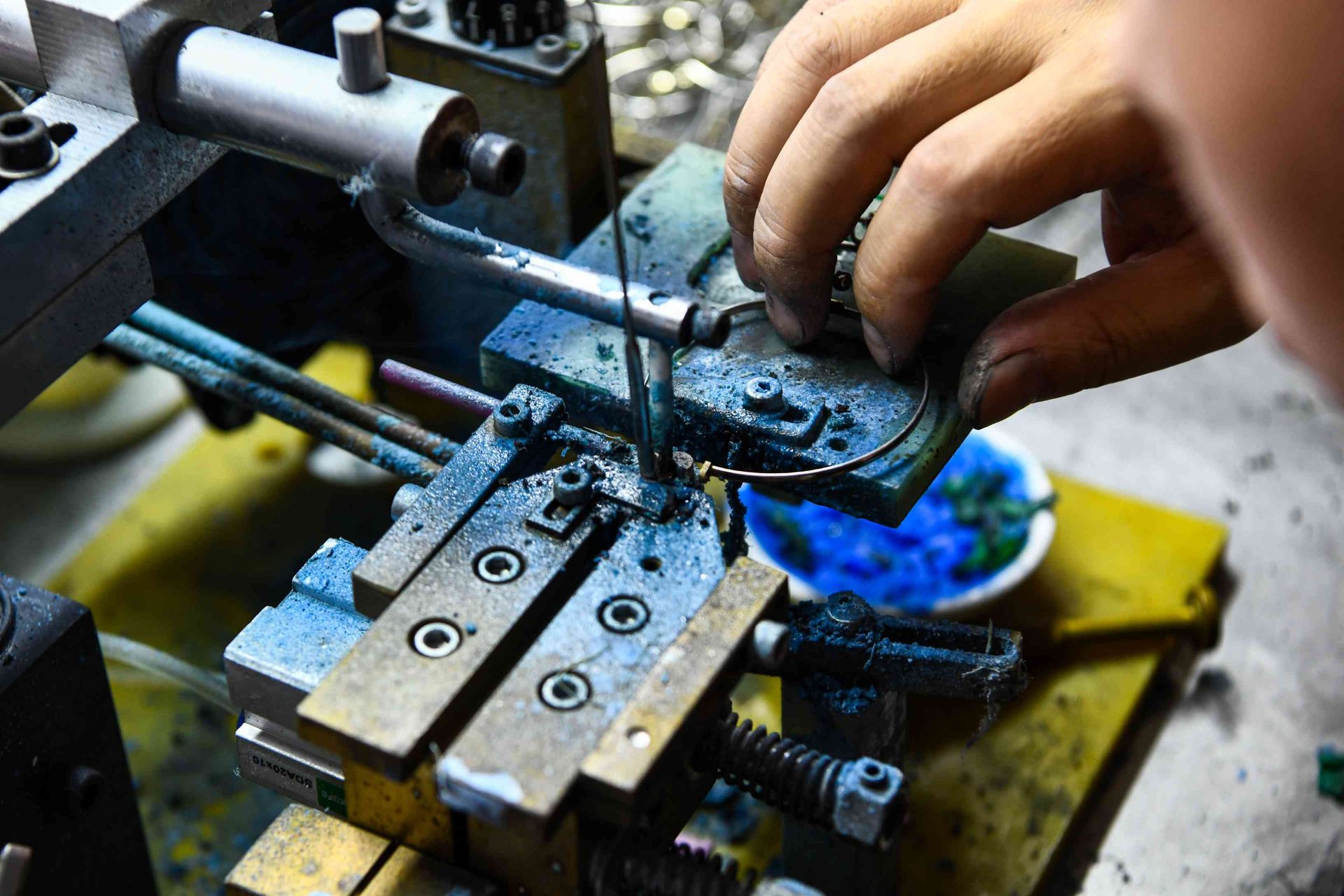 Precision welding is the defining skill in titanium frame manufacturing. Titanium welds at higher temperatures than standard alloys and demands clean, controlled conditions.
How titanium frames are made
Manufacturing titanium is a different discipline from manufacturing standard alloy or TR90 frames. The process is slower, the tooling wears faster, and the margin for error is smaller. Here is the production sequence:
1. Material inspection and cutting
Titanium sheet or wire arrives with material certificates verifying grade and composition. The raw material is cut to rough shape using CNC wire-cutting or laser cutting — both slower and more precise than the stamping used for alloy frames, because titanium’s hardness demands it.
2. Forming and shaping
Cut pieces are shaped through a combination of CNC machining and press-forming. Titanium’s strength — the same property that makes it durable — also makes it resistant to forming, so this stage takes longer than with softer metals. Complex curves may require multiple forming steps with intermediate annealing.
3. Welding
This is the most skill-dependent stage. Titanium welding requires a controlled atmosphere (typically argon-shielded) to prevent oxidation at the weld point. The welder works at higher temperatures than with stainless steel or Monel, and the weld bead must be clean and consistent — porosity or discoloration means a rejected frame. A factory that welds titanium well almost certainly welds everything else well too.
4. Polishing and surface finishing
Titanium can be finished in several ways:
- High-polish — a bright, mirror-like finish that showcases the metal’s natural luster.
- Matte / brushed — a subtle, satin texture popular in minimalist and professional styles.
- IP (Ion Plating) / PVD — a vacuum-deposited color layer. Titanium accepts IP plating well, producing rich gold, gunmetal, rose gold, and black finishes that are harder-wearing than electroplating on alloy.
- Anodizing — unique to titanium. An electrochemical process produces a range of colors (gold, blue, purple, green) without paint or plating, by controlling the oxide layer thickness. The color is integrated into the surface and won’t chip.
5. Assembly and quality control
Hinges are fitted — typically stainless steel or titanium spring hinges for premium models — and temples are mounted. Every titanium frame goes through multi-point QC: weld integrity under magnification, dimensional check against the spec, temple tension and alignment, surface finish inspection, and a final handling check for feel and fit.
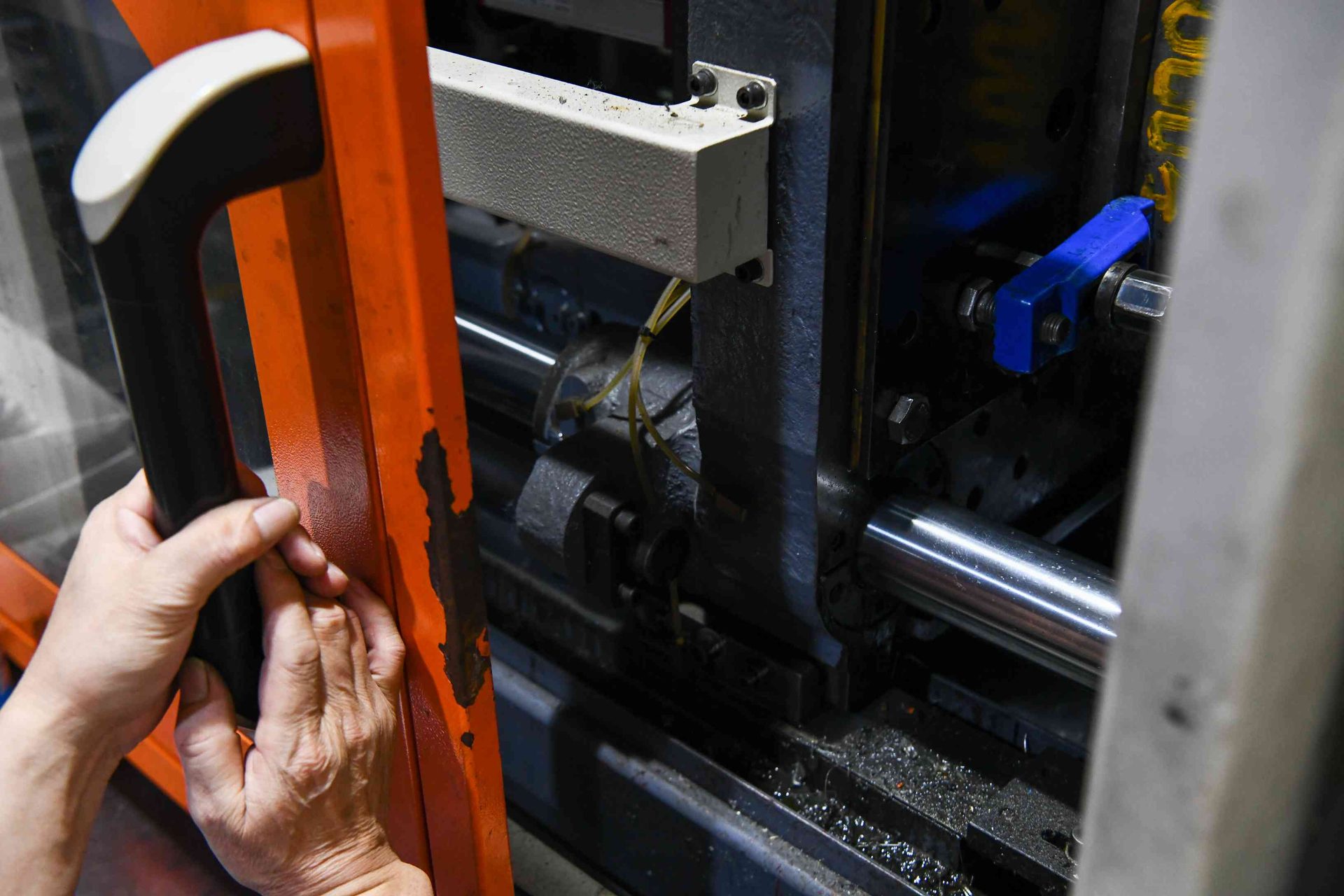 Titanium’s hardness means slower machining speeds and more frequent tool changes than softer metals — a cost that shows up in the unit price.
Titanium vs other frame materials
Where does titanium sit in the B2B material landscape? Here is a head-to-head comparison:
| Titanium | Acetate | TR90 | Metal Alloy | |
|---|---|---|---|---|
| Weight (typical frame) | 12–18 g | 22–35 g | 18–22 g | 18–28 g |
| Durability | Excellent — resists bending, doesn’t corrode | Good — can snap under impact | Excellent — flexible, impact-resistant | Moderate — can bend, plating can wear |
| Hypoallergenic | Yes — nickel-free | Yes — plant-based | Yes — thermoplastic | No — most alloys contain nickel |
| Color options | Moderate — IP/PVD plating + anodizing | Extensive — embedded color, lamination, patterns | Extensive — 50+ injection colors | Moderate — electroplating dependent |
| Design flexibility | Thin, minimalist profiles best | Thick, sculptural shapes possible | Moderate — injection-molded shapes | Good — wide range possible |
| Hand-feel | Cold, precise, luxurious | Warm, substantial, tactile | Light, slightly warm | Cool, smooth (plating-dependent) |
| Unit cost (relative) | $$$$ | $$$ | $–$$ | $$ |
| Retail price band | Premium–luxury | Mid–premium | Value–mid | Value–mid |
| Best for | Luxury optical, medical-grade, lightweight daily wear | Fashion-forward, statement styles, brand identity | Kids, sports, high-volume everyday | Budget-conscious, classic styles, promotional |
Titanium isn’t the right answer for every brand — but for any brand with a premium tier, a comfort story, or a coastal-market customer base, it’s hard to beat. For a broader comparison across all five mainstream materials, see our complete eyewear materials guide.
Quality indicators: how to judge a titanium frame
When you receive a titanium sample, here’s what to check before you approve production:
- Weight in the hand — it should feel startlingly light. If a “titanium” frame feels similar in weight to a standard metal alloy frame of the same size, be suspicious.
- Weld points — examine the bridge, endpiece, and temple joints under good light. Titanium welds should be smooth, consistent in color, and free of pits, cracks, or dark discoloration. A sloppy titanium weld is a red flag.
- Stamps and markings — genuine titanium frames are marked. The stamp should be crisp and legible, not a sticker or screen print that can be removed.
- Surface finish — on polished titanium, the luster is cooler and more silver-white than the warmer tone of polished stainless steel. IP-plated titanium should show an even, hard-wearing color with no thin spots at edges. Anodized colors should be uniform and integrated, not painted on.
- Temple flex — beta titanium temples should flex smoothly and return to their original position. Pure titanium temples are stiffer — they should not feel springy, but they should not feel brittle either.
- Hinge fit — titanium frames at the premium tier typically use high-quality barrel or spring hinges. The hinge should open and close with smooth resistance, no wobble or grinding.
- Nose pads — premium titanium frames almost always use screw-in silicon or PVC nose pads mounted on titanium pad arms. The arms should be adjustable (bendable) for a custom fit — a feature opticians value highly.
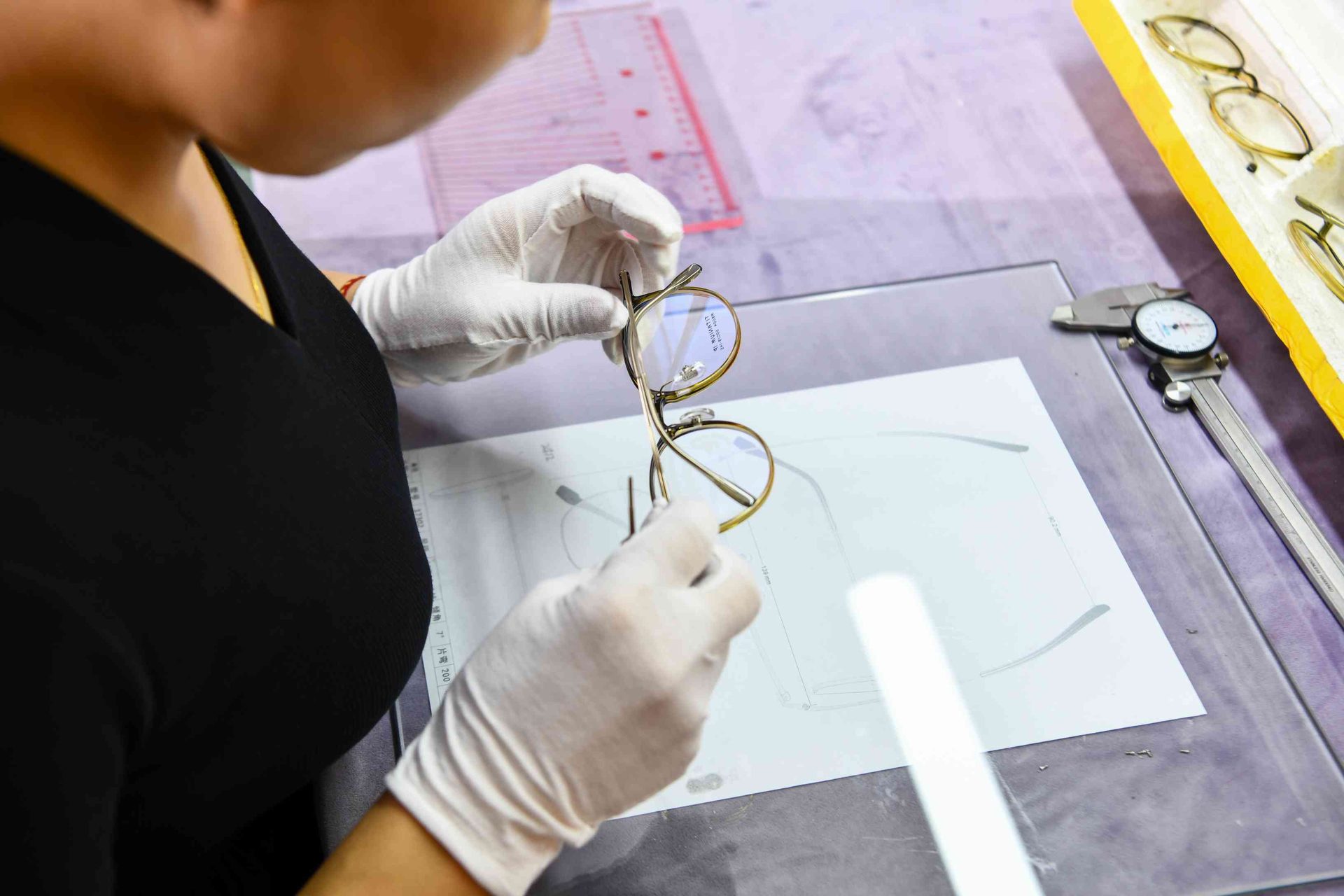 Multi-point QC inspection is standard for titanium frames. Every weld, dimension, and surface finish is checked before the frame leaves the factory.
Customization: logos, colors, and finishes
Titanium offers several customization paths that other materials don’t:
- Laser engraving — the cleanest logo method for titanium. Produces a precise, permanent mark in a slightly darker tone than the surrounding metal. Works on temples, bridges, and inside surfaces. Available from 5 pieces per style.
- IP/PVD plating — for colored titanium. The vacuum-deposition process bonds the color layer to the titanium surface at a molecular level. More durable than electroplating. Available in gold, rose gold, gunmetal, black, blue, and champagne tones.
- Anodizing — a titanium-specific process that grows a colored oxide layer. Produces vibrant golds, blues, purples, and teals. The finish is part of the metal itself — it won’t peel or chip — but it can scratch if roughly handled.
- Combination designs — pure titanium fronts with beta titanium temples, titanium fronts with acetate temple tips, or titanium rims with TR90 temple arms. Mixed-material designs let you balance cost, aesthetics, and comfort.
- Custom packaging — premium frames deserve premium packaging. Custom cases, cleaning cloths, and branded boxes complete the high-end experience. Minimums for custom packaging typically start around 1,000 pieces.
For a full breakdown of branding methods across materials, see our guide on how to add your logo to eyewear.
MOQ, pricing, and lead times: the real numbers
B2B buyers want concrete numbers. Here they are, with the necessary nuance.
MOQ
| Order type | MOQ | Notes |
|---|---|---|
| Custom OEM (new design) | ~500 pcs/style | Standard for most materials; covers mold/tooling setup |
| Custom OEM (existing mold, new color) | ~300 pcs/style | Lower because the tooling already exists |
| Custom ODM (factory design, your brand) | ~300–500 pcs/style | Faster and cheaper than full OEM |
| Ready stock | 1 pc/style | Order any quantity, mix and match across catalog |
Pricing
Titanium frames are priced at a premium, but within the titanium category, price varies by:
- Grade — pure titanium costs more than beta titanium.
- Design complexity — a simple round optical frame is cheaper than a multi-piece construction with complex bridge detailing.
- Finish — IP/PVD plating and anodizing add cost over a basic polish.
- Hinge type — titanium spring hinges cost more than standard barrel hinges.
- Quantity — as with all eyewear, the per-unit price drops as order volume rises. Moving from 500 to 2,000+ pieces can meaningfully reduce the unit cost. See our eyewear cost breakdown for the full picture.
For an accurate, itemized quote, specify your material grade, design reference, finish preference, quantity, and target market.
Lead times
| Stage | Timeline |
|---|---|
| Design confirmation & quotation | 2–5 working days |
| Sampling | 10–21 working days (titanium sampling takes longer than TR90 or standard metal) |
| Bulk production | 30–40 working days (titanium machining and welding extend the timeline vs standard materials) |
| Ready stock fulfillment | ~7 working days |
Titanium production runs about 5–10 days longer than equivalent orders in TR90 or standard metal. The slower machining, the more demanding welding, and the extra QC checks all add time — but they also add the quality that defines the category. Plan your ordering calendar accordingly.
Sourcing titanium eyewear from China
China is the world’s largest producer of titanium eyewear, and the center of that production is Danyang, Jiangsu — the eyewear capital that produces roughly half of the world’s lenses and a substantial share of its premium frames. Sourcing titanium from Danyang gives you:
- Direct access to certified titanium suppliers — the material supply chain is local, reducing cost and lead time.
- Specialized welding expertise — titanium welding is a distinct skill. Factories that have invested in argon-shielded welding stations and trained titanium welders produce visibly better results.
- Integrated production — a factory that does cutting, welding, finishing, and assembly in-house can control quality at every stage.
- Competitive economics — Danyang’s dense supplier network and skilled workforce mean you’re not paying a premium for the location on top of the premium for the material.
When evaluating a titanium manufacturer, request: material certificates, weld-quality close-up photos from a recent production run, and a physical sample before committing to bulk. Start with a small trial order — a serious factory will support it. For more on vetting suppliers, see our 10-point manufacturer checklist and our certifications guide.
Is titanium right for your brand?
Titanium isn’t for every program. If you’re competing on price in the value segment, TR90 or alloy metal is the better fit. But if your brand occupies the mid-to-premium tier — or wants to — titanium is the material that justifies the price point. It’s lighter, stronger, cleaner, and more comfortable than anything else in the cabinet, and buyers can feel the difference the moment they pick up the frame.
The brands that succeed with titanium don’t just sell a frame — they sell the experience of wearing something so light you forget it’s there. That’s the story titanium tells.
Sourcing titanium frames for your collection? Tell us your material preference, design direction, quantity, and target market. We’ll respond within 24 hours with a tailored proposal, including pricing, lead time, and a sample plan. Request a quote or browse our ready-stock catalog to explore available titanium styles.