Protective eyewear is not a fashion category. It is not sold on color trends or frame shapes. It is sold on a single promise: this product will prevent your worker from going blind today. That makes it the most regulation-intensive segment of the entire eyewear industry — and for B2B buyers, the most unforgiving of sourcing mistakes.
The global protective eyewear market is worth $4.29 billion in 2024, projected to reach $6.49 billion by 2033 at a 4.7% CAGR. Behind that growth are three forces: tightening workplace safety regulations in every developed economy, rapid industrial expansion across Asia Pacific (the fastest-growing region and already the largest at 39% of global demand), and the post-pandemic institutionalization of PPE across healthcare, laboratories, and public-sector procurement. Construction alone accounts for 37.1% of all protective eyewear consumption; manufacturing adds another 27%.
For B2B buyers — whether you are an industrial distributor, a corporate procurement manager, or a brand launching a private-label safety line — this guide covers what you need to know before placing a protective eyewear order.
Key takeaways
- The protective eyewear market is $4.29B, growing at 4.7% CAGR to $6.49B by 2033. Construction (37.1%) and manufacturing (27%) are the dominant end-user segments.
- Polycarbonate is the standard lens material — it is 10× more impact-resistant than CR-39, inherently blocks 99.9% of UV, and is specified in virtually every B2B safety eyewear order.
- Certification is non-negotiable — ANSI Z87.1 (North America), EN 166 (EU), CSA Z94.3 (Canada), and AS/NZS 1337.1 (Australia) each require specific marking, testing, and documentation. A factory that cannot produce accredited lab reports is not a viable supplier.
- B2B is the dominant channel at 60.2% of the market — bulk corporate procurement, industrial distributors, and government tenders drive the majority of volume.
- MOQs start at 500-1,000 pieces per style for custom OEM; batch certification testing adds $500-1,500 per production run and must be budgeted from day one.
The protective eyewear market: by the numbers
| Metric | Value | Source/Year |
|---|---|---|
| Global market (2024) | $4.29 Bn | SkyQuest 2025 |
| Global market (2033) | $6.49 Bn | SkyQuest 2025 |
| CAGR (2024-2033) | 4.7% | SkyQuest |
| Polycarbonate segment (2025) | $3.8 Bn | SMR 2026 |
| Non-prescription share | 67.0% | CMI 2026 |
| B2B channel share | 60.2% | CMI 2026 |
| Construction share | 37.1% | CMI 2026 |
| North America share | 39.4% | CMI 2026 |
| Asia Pacific share | 39.0% (largest region, fastest growing) | SMR 2026 |
The fastest growth is in non-prescription safety eyewear — driven by a convergence of home-improvement culture, DIY sports, and gig-economy workers buying their own PPE. The smart safety eyewear segment (AR-enabled, sensor-integrated) is an emergent subcategory that is expected to grow at double-digit rates through the rest of the decade, though from a very small base.
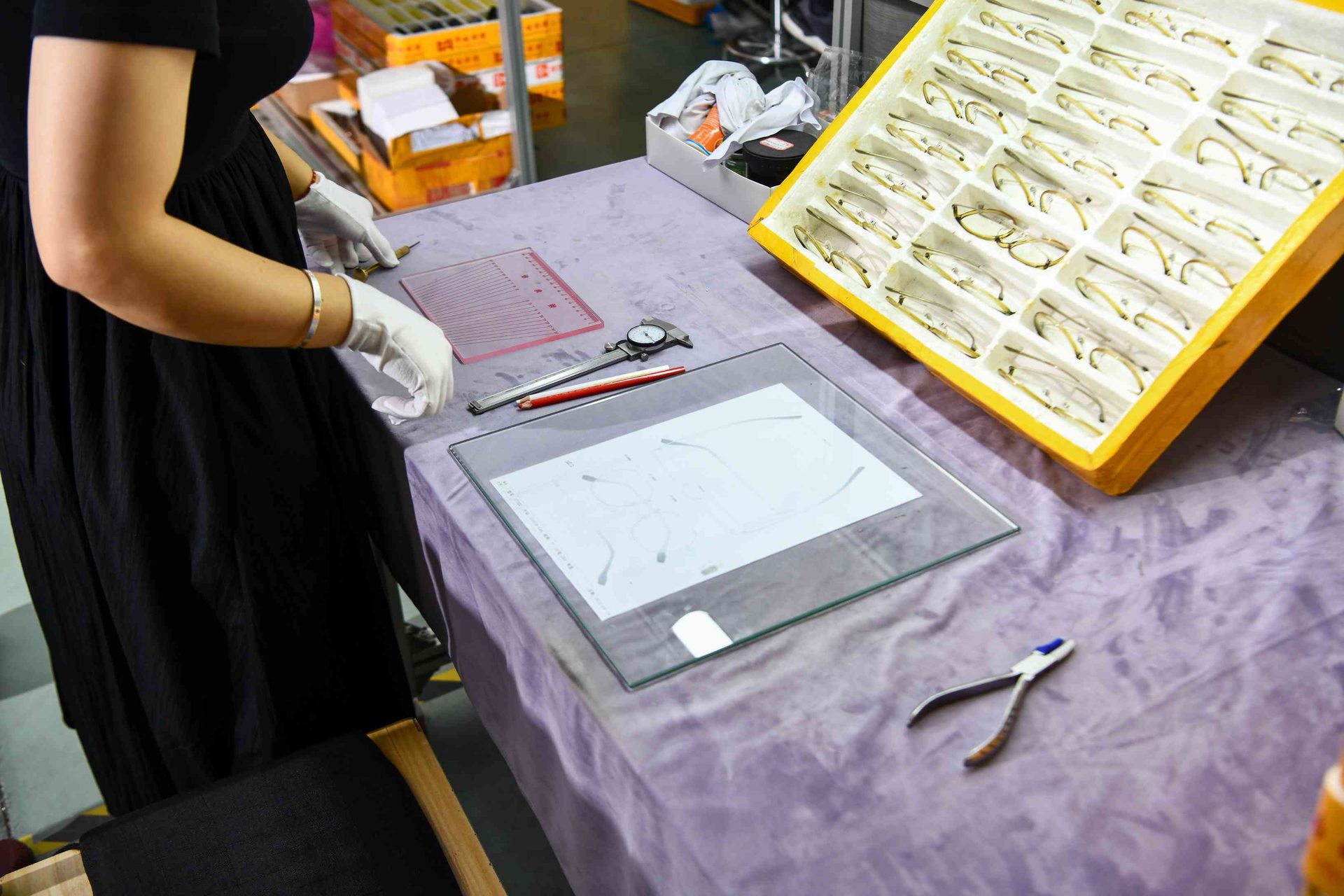 The quality control infrastructure required for protective eyewear is significantly more demanding than for fashion frames. Impact testing, optical clarity measurement, and batch documentation are not optional — they are regulatory requirements.
Safety standards: the backbone of the category
If you remember one thing from this guide, remember this: in protective eyewear, the standard is the product. A frame that looks like a safety glass but lacks the required certification marks is not a safety glass — it is a liability. Every major market has its own standard, and they are not interchangeable without additional testing.
ANSI Z87.1 (United States)
The American National Standards Institute’s Z87.1 standard is the mandatory benchmark for occupational eye and face protection in the United States. Key requirements:
| Test | What it measures | How it’s marked |
|---|---|---|
| High-mass impact | 500g pointed projectile dropped from 127 cm | ”Z87” (basic) — must withstand without lens fracture, frame breakage, or lens dislodgement |
| High-velocity impact | 6.35mm steel ball at 45.7 m/s (164 km/h) | “Z87+” (high impact) — must not fracture, pierce, or dislodge |
| Optical clarity | Refractive power, astigmatism, prismatic deviation | Lens must meet minimum optical requirements |
| Flammability | Frame material must self-extinguish within specified time | Part of basic certification |
| Frame durability | Lens retention during impact, temple strength | Part of basic certification |
The marking “Z87-2+” on a frame indicates the lens is prescription and rated for high impact. All markings must be permanent and legible — no stickers or screen prints that can be removed.
EN 166 (European Union)
EN 166 is the EU’s personal eye protection standard, mandatory for all occupational safety eyewear sold in the European Economic Area. It uses a different rating system from ANSI:
| Rating | Meaning | Typical use case |
|---|---|---|
| S (Minimum strength) | Basic impact — 22mm steel ball at 5.1 m/s | Low-risk environments, general use |
| F (Low-energy high-speed particles) | 6mm steel ball at 45 m/s | Most common B2B specification for construction and manufacturing |
| B (Medium-energy high-speed particles) | 6mm steel ball at 120 m/s | Heavy industry, mining, foundries |
| A (High-energy high-speed particles) | 6mm steel ball at 190 m/s | Military, ballistic-grade protection |
EN 166 also specifies optical class (1 = permanent wear, 2 = intermittent, 3 = occasional use only) and ratings for resistance to molten metal, hot solids, and chemical droplets.
Other key standards
| Market | Standard | Key differences from ANSI/EN |
|---|---|---|
| Canada | CSA Z94.3 | Similar to ANSI Z87.1 but requires CSA-specific marking; ANSI-certified product must be re-tested for CSA acceptance |
| Australia / NZ | AS/NZS 1337.1 | Covers both occupational and non-occupational eye protection; requires UV certification |
| Japan | JIS T 8147 | Japanese Industrial Standard for protective eyewear |
| China | GB 14866 | China’s mandatory standard for occupational eye and face protectors |
For B2B buyers targeting multiple markets, the most efficient approach is to source product certified to both ANSI Z87.1 and EN 166 from a manufacturer with testing infrastructure for both. A single design that carries dual certification opens North America, Europe, and — through mutual recognition agreements — a significant portion of the global market.
Lens materials: the polycarbonate standard
In protective eyewear, the lens material decision is simpler than in fashion eyewear — and more consequential. The wrong material choice in a fashion frame means an unsatisfied customer. The wrong material choice in a safety glass means an eye injury.
| Material | Impact resistance | Weight | Optical clarity | UV protection | Relative cost | Best use |
|---|---|---|---|---|---|---|
| Polycarbonate | Highest — 10× more than CR-39 | Lightest (18-22g finished lens) | Good — minor chromatic aberration at edges | Inherent up to 380nm | $ | The standard for B2B safety orders |
| Trivex (urethane monomer) | Very high — slightly less than polycarbonate | Very light | Excellent — closest to glass | Inherent up to 380nm | $$–$$$ | Premium prescription safety eyewear |
| CR-39 (allyl diglycol carbonate) | Low — requires thick lenses to meet impact standards | Moderate | Good | Requires coating | $ | Only for low-risk environments with thick lenses |
| Glass | Very low — shatters on impact | Heavy (2× polycarbonate) | Excellent — highest clarity | Requires coating | $ | Rarely used in modern safety eyewear |
Polycarbonate is the default and recommended choice for B2B safety eyewear. It was originally developed for aerospace applications (astronaut helmet visors) and offers a combination of impact resistance, light weight, and inherent UV protection that no other lens material matches at its price point. Virtually every non-prescription safety glass on the market uses polycarbonate lenses.
For prescription safety eyewear, Trivex is the premium upgrade. It offers marginally better optical clarity and slightly lighter weight than polycarbonate, with comparable impact resistance. The trade-off is cost — Trivex typically adds $5-15 per pair at the factory level. It is most commonly specified for workers who wear safety glasses for 8+ hours per day and need the best possible optical experience.
Lens coatings: the performance layer
An uncoated polycarbonate lens protects against impact but fails quickly in real-world conditions — it scratches, fogs in humid environments, and attracts dust. Coatings solve these problems and represent a significant portion of the value-add in B2B safety eyewear.
| Coating | Market share (2025) | What it does | Best for |
|---|---|---|---|
| Anti-scratch | 33.0% | Hard coat that reduces surface abrasion; extends lens life 2-3× | Construction, mining, heavy manufacturing |
| Anti-fog | 29.0% | Hydrophilic coating that prevents condensation; critical for mask-wearers | Healthcare, food processing, cold storage, outdoor-to-indoor workers |
| UV protection | 18.0% | UV-absorbing layer (redundant with polycarbonate but essential for other materials) | Outdoor work, any environment with UV exposure |
| Mirror coating | 11.0% | Reflective outer layer reduces glare and eye strain | Outdoor construction, road work, oil & gas fields |
| Hydrophobic | 9.0% | Water-repellent — water beads and rolls off | Rain-exposed outdoor work, marine environments |
For B2B buyers, the standard specification is anti-scratch + anti-fog dual coating on polycarbonate lenses. This combination covers the two most common causes of lens replacement — scratching and fogging — and commands the broadest market appeal. A premium specification adds mirror coating for outdoor users and hydrophobic treatment for wet environments.
Frame types: matching the design to the hazard
Protective eyewear is not one product — it is a family of products matched to specific hazard profiles. The B2B buyer’s job is to select the right frame type for the end user’s environment.
Safety glasses (spectacles)
The highest-volume category, resembling everyday eyewear but built to impact standards. Key features:
- Side shields — integrated or clip-on shields that protect against lateral debris and splashes. Required by ANSI Z87.1 for most workplace applications.
- Wraparound design — a single curved lens that provides inherent side protection; popular in construction and general manufacturing.
- Adjustable temples and nose pads — improve fit compliance; a poorly fitting safety glass is a safety glass that gets taken off.
Safety goggles
Used when the hazard includes chemical splashes, airborne dust, or high-velocity particles from all directions. Three vent types:
- Direct-vented — open vents for airflow; suitable for impact protection but not for chemical or dust hazards.
- Indirect-vented — angled or covered vents that block splashes and dust while allowing some airflow; the most common B2B goggle specification.
- Non-vented (sealed) — fully enclosed; for chemical splash and vapor protection. Requires anti-fog coating.
Face shields
For maximum-coverage protection where goggles are insufficient — grinding, chemical handling, molten metal, and healthcare settings. Face shields are typically secondary protection worn over safety glasses or goggles, not a stand-alone solution.
Industry-specific requirements
| Industry | Primary hazards | Standard spec | Special requirements |
|---|---|---|---|
| Construction | Flying debris, dust, UV exposure | Polycarbonate, Z87+, anti-scratch, wraparound | High-velocity impact rating is non-negotiable |
| Manufacturing | Grinding sparks, chemical splashes, laser | Polycarbonate, Z87+, anti-scratch + anti-fog | Indirect-vented goggles for chemical areas |
| Healthcare | Fluid splashes, infectious aerosols | Polycarbonate goggles, anti-fog, indirect-vented or sealed | Must withstand repeated disinfection without coating degradation |
| Mining | High-velocity rock fragments, dust, low light | Polycarbonate, Z87+, anti-scratch, clear or light-tinted lens | B or A-rated impact under EN 166 |
| Oil & Gas | Chemical splash, impact, UV, glare | Polycarbonate, Z87+, anti-fog + mirror coating | Explosion-proof certification may be required in specific zones |
| Logistics & Warehousing | Impact from falling objects, vehicle glare | Polycarbonate, Z87+, anti-scratch | Often combined with bump caps and high-vis vests |
| Laboratory | Chemical splash, laser | Polycarbonate goggles, anti-fog, indirect-vented | Chemical-resistance certification for specific substances |
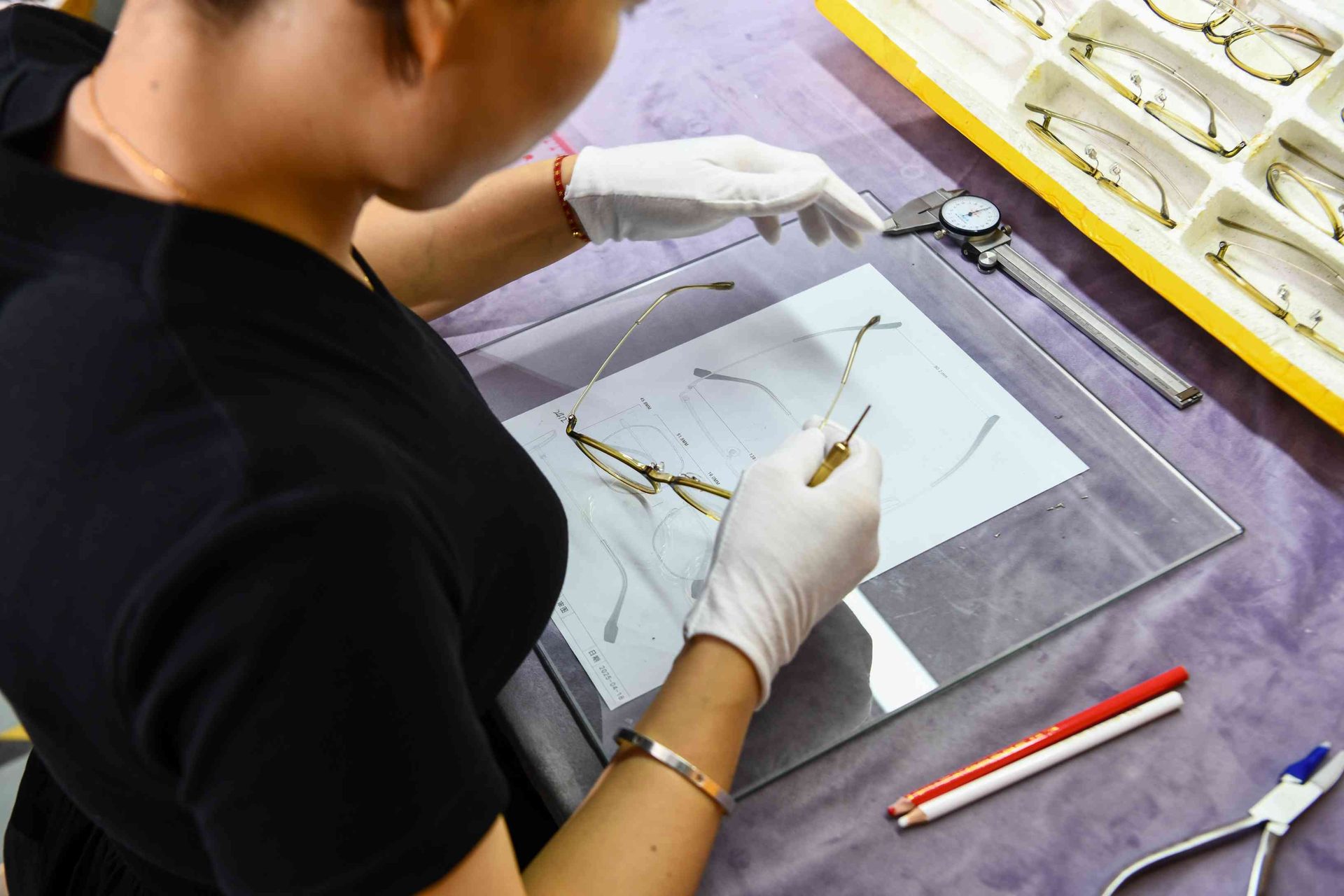 QA inspection for protective eyewear includes impact testing, optical clarity verification, and batch traceability documentation. These are regulatory requirements, not quality differentiators.
MOQ, pricing, and compliance costs
MOQ
| Order type | MOQ | Notes |
|---|---|---|
| Custom OEM safety glasses (new design) | 500-1,000 pcs/style | Covers mold setup, lens tooling, and initial compliance testing |
| Custom OEM safety goggles | 1,000-2,000 pcs/style | Higher MOQ due to more complex tooling for sealed/indirect-vented designs |
| Private label (existing certified design, your logo) | 300-500 pcs/style | Fastest path — the design is already certified; logo application does not affect compliance |
| Ready stock / bulk standard models | From 1 pc/style | Standard ANSI/EN-certified models; ideal for distributors building initial inventory |
Pricing (indicative FOB, custom OEM with polycarbonate lenses)
| Product type | Price per unit at MOQ |
|---|---|
| Standard safety glasses (Z87+) | $0.80-3.00 |
| Premium safety glasses (Z87+, dual coating, wraparound) | $2.00-5.00 |
| Indirect-vented safety goggles (EN 166 F-rated) | $2.50-6.00 |
| Sealed chemical-splash goggles | $4.00-8.00 |
| Prescription insert safety glasses | $5.00-12.00 |
| Face shields | $3.00-10.00 |
Compliance costs (fixed, one-time per design/SKU)
| Cost item | Amount |
|---|---|
| ANSI Z87.1 third-party certification (per design) | $800-1,500 |
| EN 166 third-party certification (per design) | $600-1,200 |
| Combined ANSI + EN certification package | $1,200-2,500 |
| Batch production testing (per production run) | $300-800 |
| Factory audit (on-site by SGS/Intertek/TÜV) | $2,000-5,000 (one-time, shareable across multiple SKUs) |
Compliance testing is not optional. A protective eyewear product that enters the US or EU market without valid certification documentation is subject to customs seizure, fines, and product liability exposure. Build compliance testing into your sourcing budget from day one. For more on certification strategy, see our eyewear certifications guide.
Sourcing protective eyewear from China
China is the world’s largest producer of protective eyewear, and Jiangsu province — with Danyang at its center — is the manufacturing core. The same ecosystem that produces fashion frames (skilled CNC operators, polycarbonate injection capacity, coating application expertise) also produces safety eyewear at scale. The critical difference is regulatory infrastructure: a factory that produces fashion frames successfully may or may not have the in-house testing capability, documentation systems, and accredited-lab relationships required for protective eyewear compliance.
When qualifying a protective eyewear manufacturer, ask for:
- Active ANSI Z87.1 and/or EN 166 test reports — not from a prototype, but from a recent production batch. The reports must come from an ISO/IEC 17025-accredited laboratory (SGS, Intertek, Bureau Veritas, TÜV, CSA Group). Names like “China Testing Laboratory” or “Self-Verified” without accreditation documentation are not acceptable.
- In-house testing equipment — a serious safety eyewear manufacturer maintains:
- A drop-ball tester (for ANSI high-mass impact)
- A high-velocity impact tester (for ANSI Z87+ and EN 166 F/B/A ratings)
- An optical clarity measurement setup
- A lens thickness gauge
- An anti-fog testing chamber
- Batch traceability documentation — each production batch should be traceable to the raw polycarbonate lot number, the injection molding parameters, the coating application parameters, and the QC sign-off. This is not excessive; it is standard practice in safety manufacturing.
- Design files showing compliance features — lens thickness at every point across the lens profile, side shield integration detail, temple strength specification, and marking area showing the required permanent certification marks.
- Samples from current production — not prototypes. Test them yourself: drop them on concrete from shoulder height, wear them for a day to check fit, and try to scratch the lens with a key. A sample that fails any of these informal tests is a red flag.
For related guidance on manufacturer evaluation and quality systems, see our eyewear manufacturer checklist and our quality and certifications page.
Sourcing for your market
Your specification should be driven by your target market’s regulatory environment:
- US market: Must carry ANSI Z87.1 certification with permanent frame marking. Z87+ (high impact) is the standard expectation for construction and manufacturing channels. OSHA compliance documentation should be available on request.
- EU market: Must carry EN 166 certification with CE marking. F-rating (low-energy high-speed particles) is the minimum for most occupational use. B-rating is expected for heavy industry.
- Multi-market: Specify dual ANSI + EN certification from the manufacturer. A single design tested to both standards covers approximately 75% of the global protective eyewear market.
- Australia/NZ, Canada, Japan: Each has its own national standard. Factor in additional testing cost and lead time if these markets are part of your distribution plan.
Is protective eyewear the right category for your business?
Protective eyewear is a fundamentally different business from fashion eyewear. The margins are lower — 15-30% wholesale versus 50-100% for branded fashion frames — but the volume potential is higher, the repeat-purchase rate is more predictable (safety glasses are replaced on schedule, not on impulse), and the barrier to entry is higher, which protects existing players. The buyers are different, too: industrial distributors, corporate safety managers, and government procurement officers — not boutique owners and consumers.
The upside is that once you are qualified with a compliant product and a reliable supply chain, switching costs are high for your customers. A corporate safety program that has approved your product, trained its workforce on it, and integrated it into its inventory system is unlikely to switch suppliers over a marginal price difference. That stickiness — the institutional inertia of the B2B safety market — is the category’s strongest commercial feature.
Sourcing protective eyewear for your market? Tell us your target region, the standards you need (ANSI, EN 166, or both), your volume, and your lens/coating preference. We respond within 24 hours with a tailored proposal including compliance documentation, pricing, and a sample plan. Request a quote or browse our ready-stock protective eyewear.